Showing posts with label Lilies. Show all posts

Tuesday, 9 July 2019

Biker Chic


For the past year, I've been cycling ten miles a day, four times a week, and getting nowhere.  A stationary bike, may not take you places, but an active imagination can take you anywhere!  I "travel" through wine country in France, and California, or even Canada's own Niagara and Okanagan regions, without ever leaving home.


Three years ago, I borrowed a generous Torontonian's turquoise-mint green bicycle, for a photoshoot in the park next door (https://widowsendorphins.blogspot.com/2016/08/balance-and-bicycles.html)
The photographs survive, in my computer archives.  The flowers in the park, however, are gone.  They've been dug up, in preparation for the expanded excavation of the reservoir lands.  You've heard the sarcastic expression, "take a picture, it'll last longer"?  It's true!


The park next door is not the only site undergoing massive reconstruction.  The complex where I live, is undergoing major reconstruction of our balconies.  Gone. along with the balconies, are windowboxes and planters which would be overflowing with roses, fuchsias, geraniums, begonias, dahlias, lobelia, and sweet potato vines. 
    
In search of flora and fauna, I also have fun, exploring the chrome and bright colours of the bikes in our bike racks.  The daylilies growing nearby, are a cheerful backdrop to the black and chrome handlebars of bikes, ever ready to be whisked away by their owners, on a sunny afternoon.  


I am drawn to circles, and bright colours, so photographing bicycles is always a joy.  These gleaming, new bikes were parked outside of a cycling shop in Steveston, British Columbia last July.  I look at these photographs, and recall the freshess of the salt air, and warmth of the sun that afternoon.  Happy in the knowledge, that I will return!


In my imaginary travels, every happy cycling adventure ends with a delicious picnic, luscious red wine, or chilled champagne.  Don't ask me how the champagne stays chilled on the journey...just go with it!


Photographs Copyright of:  Ruth Adams, Widow's Endorphins Photographic Images Incorporated.

Sunday, 23 June 2019

International Widows' Day 2019


It's International Widows' Day.  Truthfully, for widows around the world, every day is widows' day.  Every.  Single.  Day.  

I chose this photo of the beautiful garden gate in Victoria, British Columbia, Canada's Butchart Gardens, because it represents a divide: life and death, before and after, what is visible and invisible.  Almost every widow I know, thinks of her life in terms of before and after the death of their husband or partner.  We can tell you not only the date of death, the exact time as well.  Many (not me, because I don't think in terms of numbers), actually count the days since their husband was alive.  There's even an app for that.  


The gate may also represent the unobtainable, the barriers facing widows around the world - especially, in third world countries.  The United Nations global statistics says that of the world's 258 million widows, one out of ten live in extreme poverty.  They (and their children) are destitute.  

UN Secretary-General Antonio Guterres, says, "women are significantly more likely to suffer poverty in old age than men".  He says, "widowed women's lifetime earnings and savings are often too little to avoid poverty".  The Secretary-General says, that discriminatory inheritance rights, means that women "may be stripped of land, property and even rights and access to their own children".  In some parts of the world, widows are outcast, subjected to violence and sexual abuse, and forced to remarry. 

The UN Secretary-General is asking all of us to reflect on ensuring that widows "are not left behind". 


The most recent statistics for Canada and the United States show that there were more than 1.4 million widows in Canada, including those who were living common law.  America has ten times our population, and naturally, the statistics for widows is about ten times greater than Canada's.  In 2018, there were 11.7 million widows in the USA.  As the populations of both countries age, the number of widows grows.


There's comfort in numbers.  There's something reassuring about widows talking to other widows - discovering that they are not crazy to still hold onto a pair of his boots, or not being able to let go of shirts that are still hanging in the closet months, or years later.  

There are many on-line groups for widows, and I have found listening and sharing is healing and empowering.  To widows reading this, you are not alone.
 

One final note, relating to the garden gate...the invisible and visible doesn't just refer to life and death.  Many widows say they feel invisible.  Widows are thought of as frail, octogenarians, living in isolation.  They are in fact, young women, often living in isolation.  The average age of a widow in the US is 59 years old, and the average age in Canada is 56.

Sometimes the isolation is self imposed.  Many widows, particularly in the early months are contrary:  not wanting to be left out or excluded, and yet, not wanting to be around anyone.  If you are a friend, call them anyway, they may decline the offer, however, it will mean so much that they were thought of.

Even going to a celebration can be overwhelming for a widow.  It is a full in the face reminder that even surrounded by friends and family, they are alone.  The very person they may wish to share the joy with, isn't there.  

As I said in the beginning, every single day is widows' day.  From the moment her head hits the pillow, and all through the night until sunrise, the empty place in the bed is a reminder of being alone.  Every time a widow steps out the door, she is reminded of places and events shared with someone who is never coming back.  Every grocery trip is an aisle of his favourite foods, or if he was seriously ill, food lables which had to be carefully studied.  Eventually, it eases (after years of fanatically reading the lables of food, I never look at them anymore). 

It takes time to learn to live the life of a widow...to be just you.     

  
Photographs Copyright of:  Ruth Adams, Widow's Endorphins Photographic Images Incorporated. 

Friday, 9 November 2018

Peace Be With You


At 11 o'clock Sunday morning, it will be one hundred years since the signing of the Armistice, ending World War One.  At the eleventh hour, of the eleventh day, of the eleventh month of 1918, "the war to end all wars" ended. 
      

To say it's been an uneasy peace is a ludicrous understatement.  The past century has been called, "the bloodiest century in modern history".  Industrialization, technology and bio-technology have given warriors weapons of mass destruction unimagined centuries ago.  Hiroshima and Nagaski come to mind.  A lone wolf with a truckload of fertilizer, or a rental car, a semi automatic weapon, homemade bomb or a meat cleaver, can kill dozens of innocents.  It is estimated that more than 160 million people have been killed in wars, conflicts, and acts of terrorism in the last one hundred years.  As Joseph Stalin is oft quoted as cynically saying, one death is a tragedy, a million deaths is a statistic.  


This isn't about diminishing the courageous service and sacrifice of the young men and women who fought in these wars...those who fought for our freedom from Fascism and Nazism in the Second World War.  It is not to say that they fought in vain.  It is to acknowledge our own inhumanity.

The wars don't end when the treaties are signed.  Post Traumatic Stress Disorder is an ever present shadow in the lives of soldiers and the civilians who survived a war.  Terrorism, both foreign and homegrown, brings war to our doorstep.  And children must watch their step wherever bombs have been buried and forgotten. 

Tonight, I am reminded of how fragile peace is, even in peace time.  My sister in Melbourne lost a friend this morning.  The coffee shop owner was killed by a terrorist, who was in turn killed by police.  


This one hundredth anniversary of the end of WWI is for me perhaps more sombre than all the rest.  I truly wish you peace.  Sadly, it may not be lasting peace.  So, I wish you peace in your heart, and the strength to overcome all else.


Photographs Copyright of:  Ruth Adams, Widow's Endorphins Photographic Images Incorporated. 


Sunday, 21 January 2018

Ice, Icewine, Amaryllis and Lilies


Niagara Falls...in the middle of January.  We were there - and survived the bitter cold.  Just days before our arrival, it was so cold, the falls were frozen solid!  What you're seeing is the "thaw".  The falls in Winter are spectacular!  The turquoise green colour of the fiercely powerful water, is stunning against the ice and snow.  Further away from Horseshoe Falls, towards American Falls, the water appears dark jade green, and then, slate grey.  


I've been to Niagara Falls, and nearby Niagara-on-the-Lake (NOTL, or as the locals pronounce it, Nottle), in the hot, humid Summer, when vividly coloured flowers cascade from the hanging baskets of lamp posts, like grand floral waterfalls.  Niagara-on-the-Lake is known as "the prettiest small town in Canada".  Winston Churchill famously said, that the drive along the Niagara River, "is the prettiest Sunday drive in the world".  

When we were exploring the region a few days ago, many of Niagara Falls' tourist businesses were closed for the Winter, and parts of NOTL looked like a ghost town (it is also known as the most haunted town in Canada).  The trees along the hillside overlooking the falls were covered in ice!  It was a breathtaking, and ghostly sight!    


Niagara is world famous for another ice:  Icewine.  Hot Summers and cold Winters are ideal for producing gold medal winning, "liquid gold".  Icewine is produced from grapes which have been left on the vine after the Fall harvest, and handpicked only when temperatures drop below freezing, to -8 Celsius (17.6 F) or less.  Harvesting is done at night, when the temperatures are least likely to climb.  The grapes are immediately pressed while still frozen, to extract droplets of thick, golden yellow liquid.  By leaving them on the vine, the sugar in the grapes becomes concentrated (these grape vines have already been harvested). 


Icewine has a sweet, rich, intense flavour, and is very smooth.  The word, "luxurious" is often used to describe the experience.  Icewine is not cloyingly sweet, because the acidity balances the flavour.  Depending on the grape, the flavour may have notes of cherry, strawberry and rhubarb, or, lychee, papaya and pineapple:  Summer on your lips!


Riesling and Vidal Blanc grapes are the most common grapes used in making Icewine.  Gewurztraminer, Cabernet Franc, Merlot, Pinot Gris, and Chardonnay are also very popular.  It takes about 3.5kg (7.7 pounds) of Riesling grapes to make one 375ml (12.7 oz) bottle of Icewine.

Not only is Icewine production labour intensive, it is also risky.  Wineries will harvest grapes for wine, and leave the remaining grapes for Icewine, knowing that they may lose some, or all of these grapes to birds, hail, or high winds.  In Germany, Austria, and the Canadian Westcoast, temperatures do not always drop far enough below freezing to produce Icewine, making it an unpredictable enterprise.


In Ontario and BC, only authentic Icewine carries the VQA (Vintner's Quality Alliance) certification.  To be true Icewine, 100 percent of the grapes in the Icewine, must be grown within a specific geographic boundary (appellation); naturally frozen on the vine; harvested at -8C or below; kept frozen for immediate pressing within the same appellation; and the sweetness level must be no less than 35 degrees Brix.  A low Brix level results in the grapes being sold as, "special select late harvest".  The Icewine must be bottled within Canada, and labelled with the appellation and Brix.

Adding sugar to the wine is strictly forbidden.  Using imported grapes is forbidden.  Artificially freezing grapes is forbidden.  Years ago, during a warm Winter, a BC grower transported grapes to a higher mountain level so that they would freeze - that too, is forbidden.  Icewine made with added sugar, may as well be tossed over the falls in a barrel!


Year after year, Canadian vintners receive gold medals for Icewine, beginning in 1991, when Inniskillin Wines entered its 1989 Vidal Icewine at Vinexpo in Bordeaux, France, and won the Grand Prix d'Honneur.       
  

Our happy adventure in the land of Icewine was a memorable one...reminds me of the joke about an Englishman, a Russian and an Italian who walk into a bar, and order a bottle from NOTL...


Photographs Copyright of:  Ruth Adams, Widow's Endorphins Photographic Images Incorporated.

Tuesday, 2 August 2016

Mucha Do About Lilies


Alphonse Mucha.  His name is synonymous with Art Nouveau, the turn of the last Century art form characterized by flowing, organic, feminine forms, and ornate design.  I think of him, at this time of year, when intertwining lilies grow in abundance. 


Mucha believed it was his duty as an artist, to create beautiful art for everyone - rich or poor. Together with his printer, Imprimerie Champenois, he created a new art genre - the decorative panel. They were the original art posters.  The panels were beautifully illustrated, and widely available.  Mucha believed that through beautiful art, the quality of life was improved.


Born in 1860, in Ivancice, Moravia, now part of the Czech Republic, Mucha was drawing pictures from the time he was a little boy.  He worked in Vienna as a theatre set painter, and took art classes at night. When fire destroyed the theatre, killing 400 people, he found commissioned work painting decorative scenes on the walls, ceilings and furniture in the castles of wealthy families.  A Count became his patron, and paid for years of formal art training.  Then, the money stopped.  Mucha took commissions for illustrations for French and Czech publications.  One of those publications, Le costume au theatre et a la ville, published by Lemercier, was a Godsend.

As a favour to a friend at Lemercier's printing shop, he spent the day after Christmas, correcting proofs. The famous melodramatic actress, Sarah Bernhardt called on the printer, urgently needing a new poster for her production of Gismonda, which was opening the following week.  All the artists were on Christmas holiday, so Mucha worked his magic.


By New Year's Day 1895, Mucha's posters were up all over Paris.  The Gismonda poster, with its elongated shape, near life-size figure of Bernhardt, and subtle pastel colours, caused a sensation, and collectors were using razor blades to remove posters off hoardings in the dead of night.

Bernhardt must have liked the way her image looked placed in an archway, like a saint in a grotto, with a halo shape around her head, because she offered Mucha a six-year contract to not only produce her posters, to design her theatre sets and costumes, as well.  After that, he was sitting pretty!


There are those lilies!  In this 1896 Sarah Bernhardt poster, the six petals of the lilies, create a softer, wilder balance to the more angular Star of David design in the background.  A Catholic, Mucha often placed a circular halo shape around a woman's head, similar to the elaborate golden halos found in Byzantine art.

Lilies are not sweet, little girl flowers.  Lilies are all woman:  exotic, elegant, and powerful, with a simplicity, purity and organic quality that make them one of the most complex flowers to paint and photograph.  Like a great actress, lilies can play almost any role, conveying the solemnity of a funeral, the exotic, bohemian or refined.
  

By 1896, Mucha was working with one of the most prestigious printing houses in Europe, Imprimerie Champenois, which commissioned him to do a series of decorative panels illustrating the four seasons.  These were so popular, that other decorative panel series were produced:  flowers (including the Lily panel below), the times of the day, and gemstones.  


The mass-produced decorative panels were affordable.  "I was happy", he later wrote, "to be involved in an art for the people and not for private drawing rooms.  It was inexpensive, accessible to the general public, and it found a home in poor families as well as in more affluent circles." 


Everyone was asking for the Mucha touch.  Champenois began putting Mucha's art on calendars, postcards, theatre programmes, menus, and began licensing designs and illustrations to companies in Europe and North America.  Mucha's illustrations were on everything from chocolate to champagne. One of the most recognized, is the Moet & Chandon Grand Cremant Imperial poster.


There is so much variation within the Lily family.  I photographed these three varieties over the long weekend:  the speckled pink and white Stargazer Lily, the dusty rose Asiatic Lily, and the orange double Day Lily which grows in "my backyard garden".


Women with long, flowing hair are a signature of Mucha's work.  In this 1902 poster for the British company, Cycles Perfecta, the woman is stationary, yet, her flowing, windswept hair, create the sensation of movement, and a sense of freedom.


Mucha spent much time in America.  In 1909, he painted an oil on canvas work depicting American actress Maude Adams in her one-night gala performance of Joan of Arc.  Mucha also created the theatre sets and costumes for the production. The Joan of Arc painting remained in the lobby of the Empire Theatre in New York City.  Take a closer look at the painting, and you'll see the repetitive shape of lilies, framing the figure.  After all, the fleur de lis is as French as Joan of Arc.


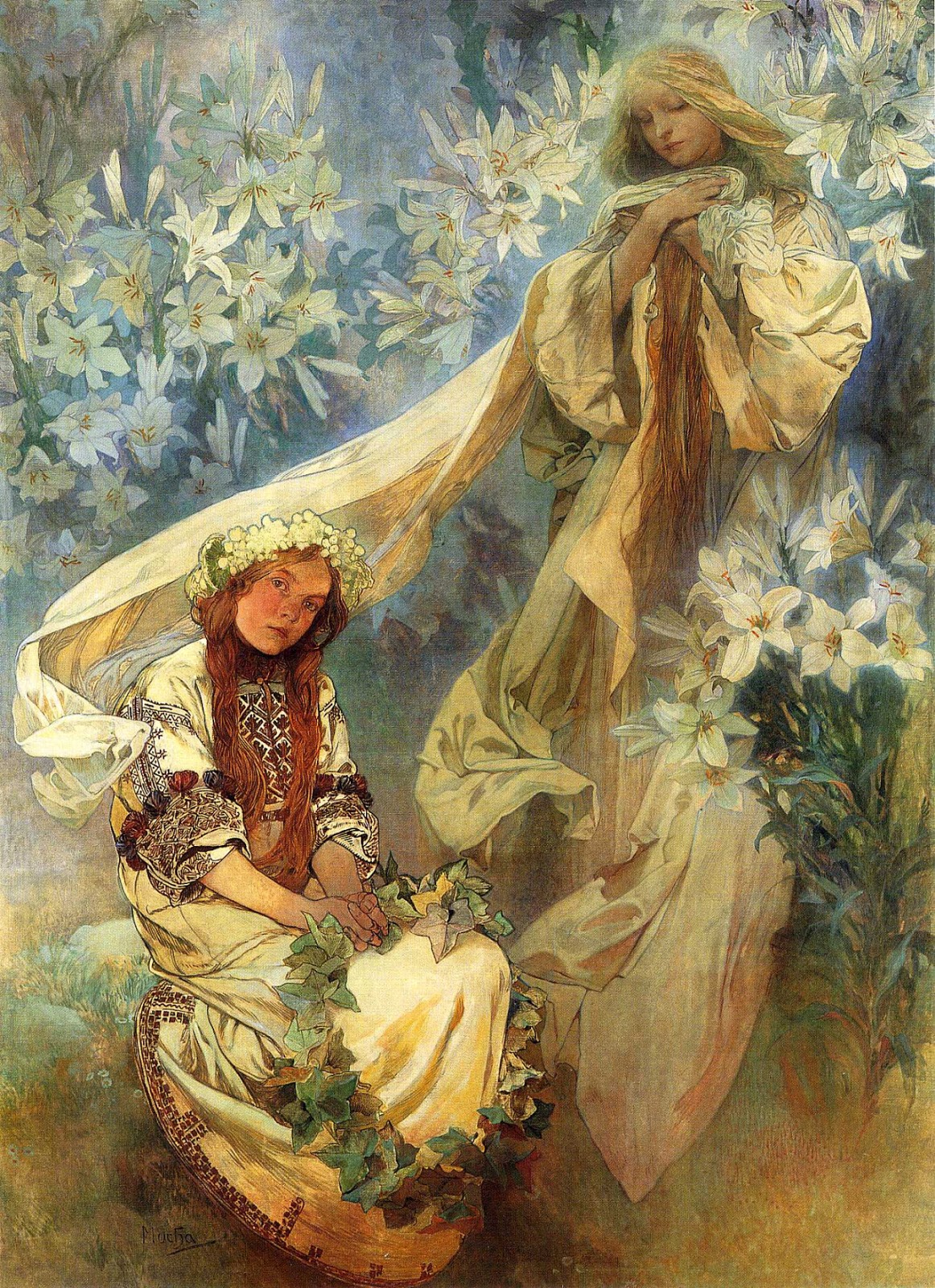
Madonna of the Lilies is famous - even as an unfinished work.  This is what was to have decorated the walls of a Jerusalem church dedicated to the Virgin Mary.  The 1905 painting uses lilies as a sign of purity, and the wreath of ivy, a sign of remembrance.


Although he travelled extensively all his life, Mucha was in his heart, a Czech.  His later years were spent painting enormous canvasses telling the story of the Slav people.  The Slav Epic, often described as a "monumental" work, depicts the history of the Slav people from ancient times.  The largest is six by eight metres (20 by 26 feet).  If you are in Prague, Czech Republic, visit the Mucha Museum to see his impressive work.


Mucha died just days before his 79th birthday, having lived an extraordinary life.  I didn't even talk about his early childhood memories of one of the worst battles between Prussia and Austria, which took place about 20 miles from his home, leaving 53-thousand dead, wounded or missing;  I didn't even mention the epiphany he had in St Wenceslas Church, when he realized an artist could make a living; not a word about his late in life marriage and children;  no mention of his 1934 Officier de la Legion d' Honneur award, or that he was arrested and interrogated by the Gestapo for his Masonic Temple activities...you'll just have to read about all of his life on-line, at the Mucha Foundation.


The Mucha Foundation was begun by his late Daughter-in-Law, and his Grandson to preserve and promote Mucha's legacy.  The Mucha Trust collection is the world's largest collection of Mucha's art. It has more than 3-thousand works of art, 4-thousand photographs, and a written archive...and a few lilies!


Lily photographs copyright of:  Ruth Adams, Widow's Endorphins Photographic Images Incorporated
Everything else, courtesy of The Mucha Foundation's Mucha Trust.