Sunday, 16 July 2017

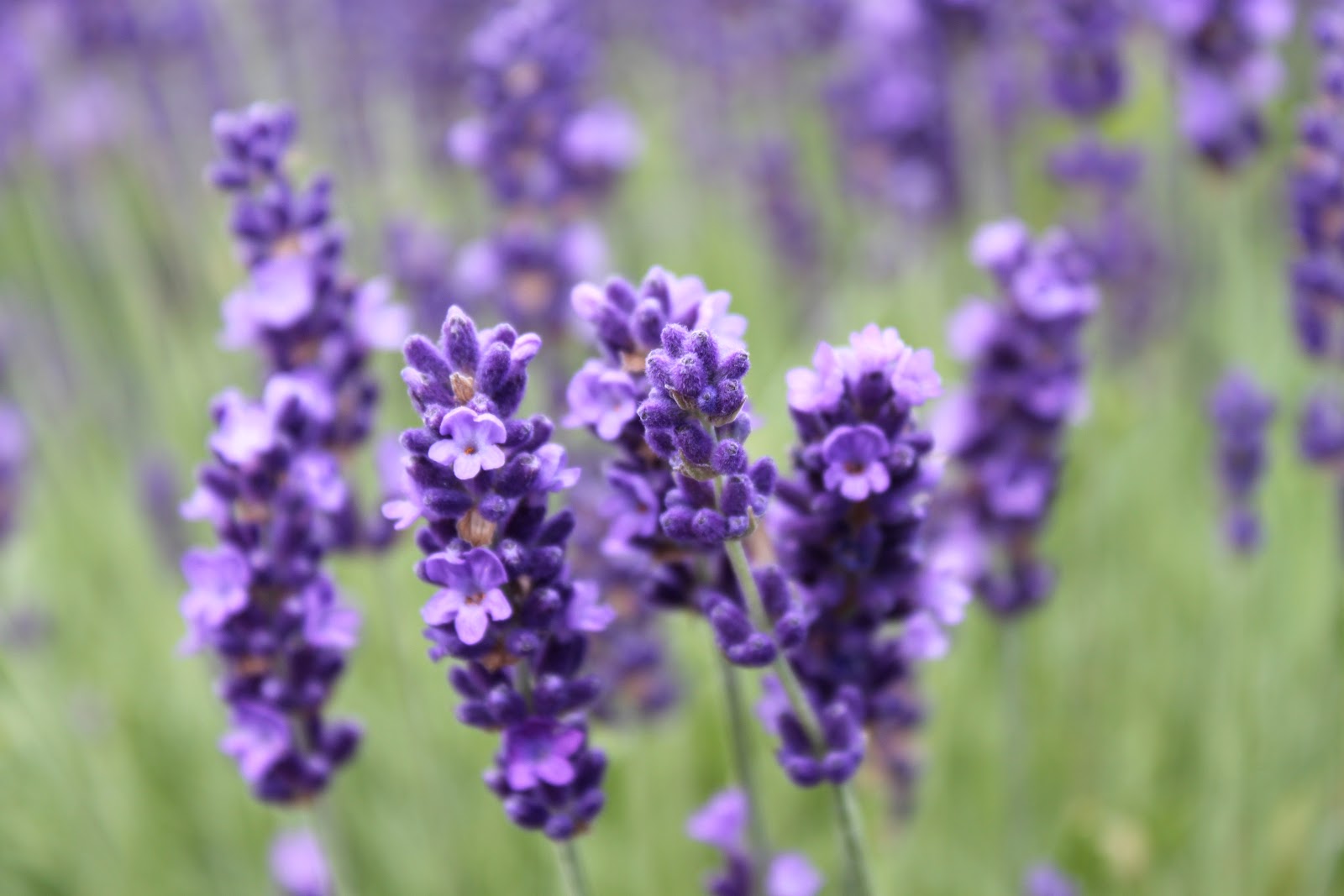
Lavender Honey


After Mama and Papa, my first word was probably miel, which is French for honey.  I have loved honey for as long as I can remember.  I still have a little comic book about bees and honey, published by a Canadian honey producer in the early '60s.

An early childhood memory is of the big jar of crystalized honey, which my Grandparents bought in British Columbia's Boundary-Similkameen region. The honey was placed high above the kitchen cupboards, beckoning to be used on morning toast. Like Winnie-the-Pooh, I could have stuck my whole head in a jar of the stuff! 


Bees will travel three kilometres (just under two miles) from the hive, sometimes further.  They pollinate many varieties of plants along the way.  It is impossible to control their flight path (I have an image of hundreds of little bee harnesses, getting tangled up as they buzz from field to field).  To produce single flower honeys, such as clover, strawberry or blueberry, farmers need to plant a single crop stretching about three kilometres in every direction, or, like the Beatles song says, Strawberry Fields forever!

Lavender Honey is one of the rarest of the world's varieties of honey.  If you are fortunate to live near a lavender farm with it's own bee hives, you may have tasted the lightly floral, lavender flavour of their honey.


An on-line American company sources its lavender honey from a "remote region" in Southern Spain. They describe it as being light in colour, with a "slightly purple hue".  Closer to home, the largest lavender farm in Ontario, Terre Bleu, in Milton, Ontario, produces lavender honey.  In addition to equestrian stables, the farm has its own apiary, or bee hives.  The Globe and Mail describes their lavender honey as, "gorgeous...the kind of honey that must be tasted straight up on a spoon first, then drizzled over top-notch ice cream".

You can make your own lavender flavoured honey.  While not true lavender honey, it will taste of lavender. You'll need a mild honey, such as clover (buckwheat is way too strong).  Use just under a cup of honey for a small bunch of fresh or dried lavender blossoms (about fifteen blossoms). Gently heat the honey in a saucepan, and add the lavender. Let it cool, and refrigerate it overnight. Then, reheat it over medium heat, and strain the blossoms through a sieve so that you are left with clear honey.  Et, voila!  


Photographs Copyright of:  Ruth Adams, Widow's Endorphins Photographic Images Incorporated.

Sunday, 9 July 2017

Widow's Endorphins: Delphiniums

Widow's Endorphins: Delphiniums: Delphinium.  By the time you've said the name, Summer's over!  There are two different stories about the origin of the name. One...

Delphiniums


Delphinium.  By the time you've said the name, Summer's over!  There are two different stories about the origin of the name. One version, is that the tall, spikey, multi-flowered plant is named for the ancient Greek city of Delphi, home to the Oracle of Delphi.


The plant was orignally named Delphinium Apollo, after the Greek god of the sun (you know, Zeus' son).  Apollo was not only the sun god, he presided over art, music, poetry, prophecy, truth, light, and healing.  He taught mortal men the art of medicine.  He could also bring on plagues.

That may be another link between Apollo and delphiniums.  As beautiful as they are, delphiniums are toxic to both humans and livestock.  They can kill cattle. Strangely, domestic sheep are immune to the plant's poison.


Delphiniums have five sepals, forming a small pocket with spurs at one end.  In days gone by, the spurs reminded English farmers of the sharp spurs on the claws of meadow larks, thus the other name for delphinium - Larkspur.


Depending on the variety, this perennial will grow anywhere from three to seven feet, making it a favourite choice for gardeners creating structure, and drama in a garden.  The plants need to be staked, otherwise they may topple over in a strong wind.


Blue is an unusual, and therefore sought-after colour in a garden.  Delphiniums come in all shades of blue - ethereal blue, powder blue, lavender, lapis, purple, and indigo.  There are also white delphiniums, pink delphiniums, rare red delphiniums (Cardinale Delphiniums), and even rarer bright yellow delphiniums, which grow in California.


But, I digress...I said there were two stories about the origins of the name.  The second story requires imagination.  A lot of imagination.  The flowers are said to resemble dolphins leaping out of the water.  The Greek word for dolphin?  Delphin.  

I poured through botanical images to find anything that looked like leaping dolphins, and found one image.  This 1820 illustration (below) does capture that frolicking dolphin look.  Apollo believed dolphins were sacred creatures. 


Were the flowers named for Apollo's city of Delphi, or for the dolphins he revered?  I do not have the answer.  Like the great Oracle of Delphi, I will make this prophecy:  if you plant delphiniums in your garden this year, you'll enjoy them for years to come!


Botanical illustration (1820), The Botanical Register, Wiki Images.
Photographs Copyright of:  Ruth Adams, Widow's Endorphins Photographic Images Incorporated.

Wednesday, 5 July 2017

Widow's Endorphins: Sweet Peas

Widow's Endorphins: Sweet Peas: In the language of flowers, Sweet Peas mean "blissful pleasure".  These early Summer blooms have an ethereal fragance, that ...

Sweet Peas


In the language of flowers, Sweet Peas mean "blissful pleasure".  These early Summer blooms have an ethereal fragance, that is delicate and sweet, yet, powerful enough to evoke distant memories of warm Summer mornings.  


I bought this small bouquet last Saturday, at the local farmers' market, here in Toronto.  The transluscent blossoms were beautifully displayed in simple Mason jars.  The young farmer was especially proud of the variegated sweet peas he had imported as seeds, from a grower in the Pacific Northwest. I was sold, just inhaling the fragrance of the bouquet.  


Sweet peas are grown from seed each year.  In cold climates, the seeds are started indoors in late Winter, and transplanted in late Spring.  In the South, gardeners sow sweet peas after Labour Day, and they grow in the Spring. 


A climbing vine with delicate tendrils, sweet peas grow best if they have something to cling to.  They will grow taller than most basketball players, if they have string, netting or a fine trestle to climb. They love sunshine!  Plant them in a place that gets full sun to part shade, in rich, well drained soil, and they'll rise to the occasion.     


Sweet peas are an old fashioned flower, popular during Queen Victoria's reign.  The Queen of England loved them, and so did the "queen of the house", in every home, on every street and country lane in North America.


Although we think of sweet peas as British or American, they originated in Italy.  In 1695, Franciso Cupani, who may or may not have been a monk with the Order of St. Francis, was caring for their botanical garden in Misilmeri, not far from Palermo, Sicily, when he discovered a new plant.  He named it, Lathyrus distoplatyphylos, hirsutus, mollis, magno et peramoeno, flare ororo, or in simpler terms, fragrant (odoratus) pea (lathryrus).


While the fragrance is intoxicating, the flower is a neurotoxin.  Perhaps it was Dr. Casper Commelin, a botanist of the School of Medicine in Amsterdam, Netherlands who discovered that.  Who knows. Dr. Commelin was one of the international botanists who received the seeds of the newly discovered plant from Cupani.  In 1701, Commelin published his observations, along with the first illustrations of the flowering sweet pea.

It was a Scottish nurseryman, Henry Eckford who raised the sweet pea to new heights, crossbreeding the original plant to create larger blossoms, in beautiful colours.

Modern day breeders have tended to favour more colourful varieties of sweet peas.  If you want to grow more fragrant sweet peas, choose "old fashioned", or "heritage" varieties.


Photographs Copyright of:  Ruth Adams, Widow's Endorphins Photographic Images Incorporated.

Wednesday, 28 June 2017

Widow's Endorphins: Au Revoir, Mum

Widow's Endorphins: Au Revoir, Mum: I will say , au revoir, Mum.  The French for goodbye is not final.  The translation for au revoir is, until we see one another again, or...

Au Revoir, Mum


I will say, au revoir, Mum.  The French for goodbye is not final.  The translation for au revoir is, until we see one another again, or until we meet again.

Our mother, Marie-Paule died on Monday morning, at the age of 93.  She was paralyzed more than 30 years ago, and I have been caring for her for more than half of my adult life.  It was a beautiful privilege.


Photographs Copyright of:  Ruth Adams, Widow's Endorphins Photographic Images Incorporated.