
Alphonse Mucha. His name is synonymous with Art Nouveau, the turn of the last Century art form characterized by flowing, organic, feminine forms, and ornate design. I think of him, at this time of year, when intertwining lilies grow in abundance.

Mucha believed it was his duty as an artist, to create beautiful art for everyone - rich or poor. Together with his printer, Imprimerie Champenois, he created a new art genre - the decorative panel. They were the original art posters. The panels were beautifully illustrated, and widely available. Mucha believed that through beautiful art, the quality of life was improved.

Born in 1860, in Ivancice, Moravia, now part of the Czech Republic, Mucha was drawing pictures from the time he was a little boy. He worked in Vienna as a theatre set painter, and took art classes at night. When fire destroyed the theatre, killing 400 people, he found commissioned work painting decorative scenes on the walls, ceilings and furniture in the castles of wealthy families. A Count became his patron, and paid for years of formal art training. Then, the money stopped. Mucha took commissions for illustrations for French and Czech publications. One of those publications, Le costume au theatre et a la ville, published by Lemercier, was a Godsend.
As a favour to a friend at Lemercier's printing shop, he spent the day after Christmas, correcting proofs. The famous melodramatic actress, Sarah Bernhardt called on the printer, urgently needing a new poster for her production of Gismonda, which was opening the following week. All the artists were on Christmas holiday, so Mucha worked his magic.
As a favour to a friend at Lemercier's printing shop, he spent the day after Christmas, correcting proofs. The famous melodramatic actress, Sarah Bernhardt called on the printer, urgently needing a new poster for her production of Gismonda, which was opening the following week. All the artists were on Christmas holiday, so Mucha worked his magic.

By New Year's Day 1895, Mucha's posters were up all over Paris. The Gismonda poster, with its elongated shape, near life-size figure of Bernhardt, and subtle pastel colours, caused a sensation, and collectors were using razor blades to remove posters off hoardings in the dead of night.
Bernhardt must have liked the way her image looked placed in an archway, like a saint in a grotto, with a halo shape around her head, because she offered Mucha a six-year contract to not only produce her posters, to design her theatre sets and costumes, as well. After that, he was sitting pretty!


There are those lilies! In this 1896 Sarah Bernhardt poster, the six petals of the lilies, create a softer, wilder balance to the more angular Star of David design in the background. A Catholic, Mucha often placed a circular halo shape around a woman's head, similar to the elaborate golden halos found in Byzantine art.
Lilies are not sweet, little girl flowers. Lilies are all woman: exotic, elegant, and powerful, with a simplicity, purity and organic quality that make them one of the most complex flowers to paint and photograph. Like a great actress, lilies can play almost any role, conveying the solemnity of a funeral, the exotic, bohemian or refined.

By 1896, Mucha was working with one of the most prestigious printing houses in Europe, Imprimerie Champenois, which commissioned him to do a series of decorative panels illustrating the four seasons. These were so popular, that other decorative panel series were produced: flowers (including the Lily panel below), the times of the day, and gemstones.

The mass-produced decorative panels were affordable. "I was happy", he later wrote, "to be involved in an art for the people and not for private drawing rooms. It was inexpensive, accessible to the general public, and it found a home in poor families as well as in more affluent circles."

Everyone was asking for the Mucha touch. Champenois began putting Mucha's art on calendars, postcards, theatre programmes, menus, and began licensing designs and illustrations to companies in Europe and North America. Mucha's illustrations were on everything from chocolate to champagne. One of the most recognized, is the Moet & Chandon Grand Cremant Imperial poster.


There is so much variation within the Lily family. I photographed these three varieties over the long weekend: the speckled pink and white Stargazer Lily, the dusty rose Asiatic Lily, and the orange double Day Lily which grows in "my backyard garden".

Women with long, flowing hair are a signature of Mucha's work. In this 1902 poster for the British company, Cycles Perfecta, the woman is stationary, yet, her flowing, windswept hair, create the sensation of movement, and a sense of freedom.


Mucha spent much time in America. In 1909, he painted an oil on canvas work depicting American actress Maude Adams in her one-night gala performance of Joan of Arc. Mucha also created the theatre sets and costumes for the production. The Joan of Arc painting remained in the lobby of the Empire Theatre in New York City. Take a closer look at the painting, and you'll see the repetitive shape of lilies, framing the figure. After all, the fleur de lis is as French as Joan of Arc.


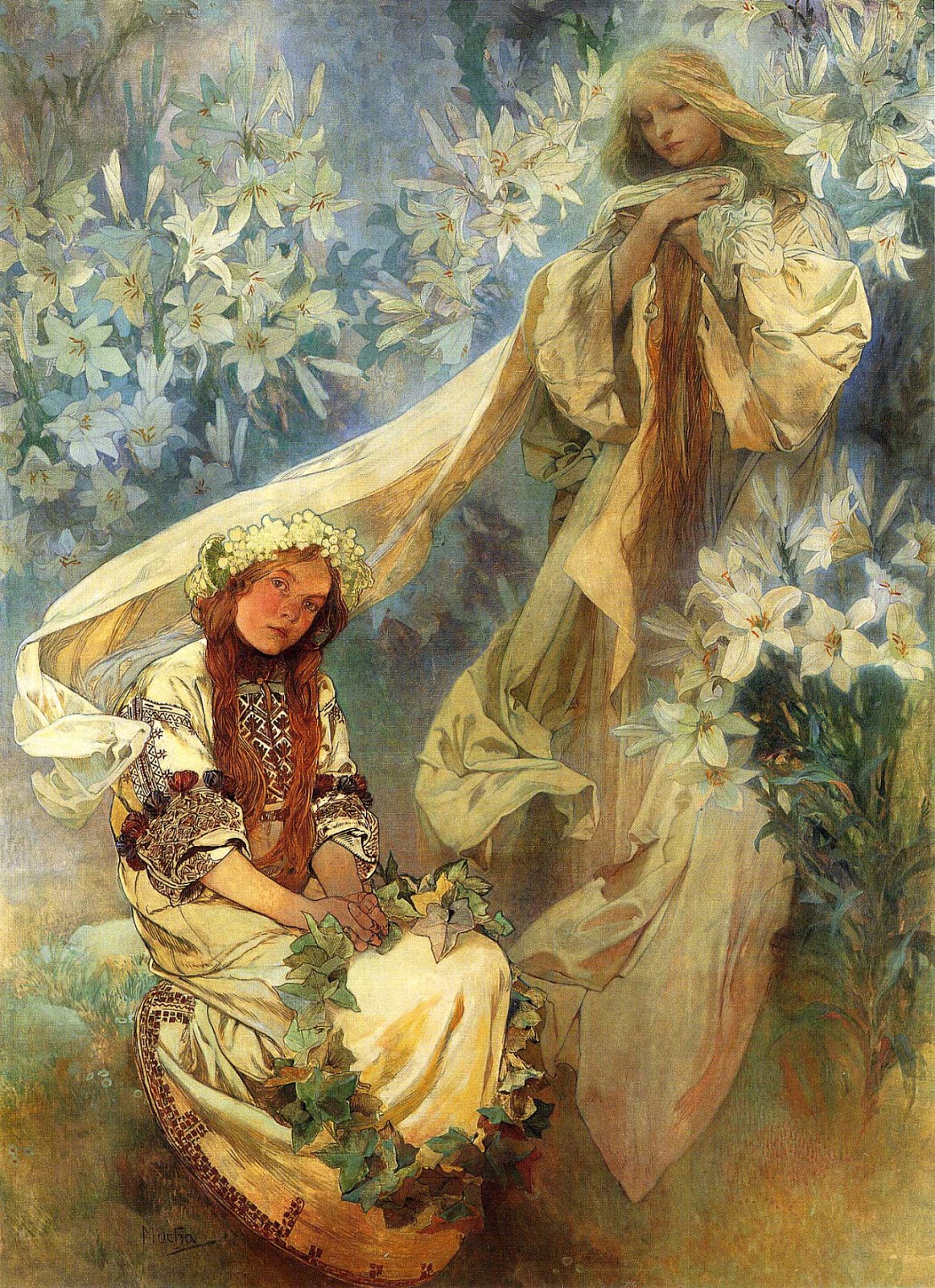
Madonna of the Lilies is famous - even as an unfinished work. This is what was to have decorated the walls of a Jerusalem church dedicated to the Virgin Mary. The 1905 painting uses lilies as a sign of purity, and the wreath of ivy, a sign of remembrance.
Although he travelled extensively all his life, Mucha was in his heart, a Czech. His later years were spent painting enormous canvasses telling the story of the Slav people. The Slav Epic, often described as a "monumental" work, depicts the history of the Slav people from ancient times. The largest is six by eight metres (20 by 26 feet). If you are in Prague, Czech Republic, visit the Mucha Museum to see his impressive work.


Mucha died just days before his 79th birthday, having lived an extraordinary life. I didn't even talk about his early childhood memories of one of the worst battles between Prussia and Austria, which took place about 20 miles from his home, leaving 53-thousand dead, wounded or missing; I didn't even mention the epiphany he had in St Wenceslas Church, when he realized an artist could make a living; not a word about his late in life marriage and children; no mention of his 1934 Officier de la Legion d' Honneur award, or that he was arrested and interrogated by the Gestapo for his Masonic Temple activities...you'll just have to read about all of his life on-line, at the Mucha Foundation.

The Mucha Foundation was begun by his late Daughter-in-Law, and his Grandson to preserve and promote Mucha's legacy. The Mucha Trust collection is the world's largest collection of Mucha's art. It has more than 3-thousand works of art, 4-thousand photographs, and a written archive...and a few lilies!

Lily photographs copyright of: Ruth Adams, Widow's Endorphins Photographic Images Incorporated
Everything else, courtesy of The Mucha Foundation's Mucha Trust.
Everything else, courtesy of The Mucha Foundation's Mucha Trust.


